
If you've spent any time shopping for dog treats lately, you've probably noticed "freeze-dried" and "dehydrated" used almost interchangeably. They're not the same thing – and the difference actually matters for the nutrition you're paying for.
Both methods remove moisture to make treats shelf-stable without preservatives. But how they remove that moisture is where things diverge, and that difference affects everything from nutrient retention to texture to shelf life. Here's what's actually happening in each process, and how to think about it when you're comparing dehydrated dog treats vs. freeze-dried.
 What Is Freeze-Drying?
Freeze-drying (technically called lyophilization) starts by freezing the ingredient solid, then placing it in a vacuum chamber. Under that vacuum, the frozen moisture inside the food converts directly from ice to vapor – a process called sublimation – without ever passing through a liquid state.
Because the food stays frozen through most of the process, no meaningful heat is ever applied. That's the core distinction: freeze-drying pulls moisture out in the cold, not with heat.
The result is a treat that's remarkably close in structure, and closer to raw feeding, than any heat-based method – often retaining its original shape, color, and much of its aroma. It's also why freeze-dried treats rehydrate so quickly if you choose to add warm water or broth.
What Is Dehydrating?
Dehydrating takes the opposite approach: it uses low, continuous heat, typically somewhere in the 95°F to 165°F range, applied over several hours to draw moisture out through evaporation.
It's a simpler, older process, and it still removes a lot of water (dehydrated treats typically land around 90–95% moisture removal, versus 98–99% for freeze-dried). But because heat is involved for an extended period, some heat-sensitive vitamins and enzymes degrade along the way. It's a stat you'll hear often from raw feeding advocates and pet nutrition writers: the more heat and time involved in processing, the more nutrient loss you can expect. Exact retention numbers vary a lot depending on the source, the protein, and the specific equipment used, so treat any precise percentage you see quoted online with a healthy dose of skepticism.
So Which One Preserves More Nutrition?
The honest answer: it depends on the source, but the mechanism gives freeze-drying a real edge. Since no heat is involved at any point, freeze-drying is generally regarded as the gentler process for preserving heat-sensitive nutrients like certain B vitamins and naturally occurring enzymes. Dehydrating still preserves the majority of a food's protein and amino acid content, it just does so with more heat exposure along the way.
Neither process adds preservatives. Both rely purely on moisture removal to make a shelf-stable product, which is a meaningful upgrade over baked or extruded treats loaded with fillers.
Texture, Shelf Life, and Practical Differences
| Freeze-Dried | Dehydrated | |
|---|---|---|
| Process | Frozen, then moisture removed under vacuum via sublimation (no heat) | Moisture removed with low, continuous heat over several hours |
| Moisture removed | ~98–99% | ~90–95% |
| Texture | Light, crisp, often crumbles easily | Firmer, chewier, more resistant to crumbling |
| Rehydration | Fast – rehydrates in minutes if water or broth is added | Slower, denser even when rehydrated |
| Shelf life | Very long when stored properly | Long, but generally shorter than freeze-dried |
Neither texture is "better" across the board – it depends on your dog. Freeze-dried single-ingredient pieces work well for dogs who prefer a lighter bite or for owners who want to break treats into smaller pieces for training. Dehydrated and air-dried chews tend to hold up better for dogs who like to work at a treat over time.

Where Momentum's Products Fit
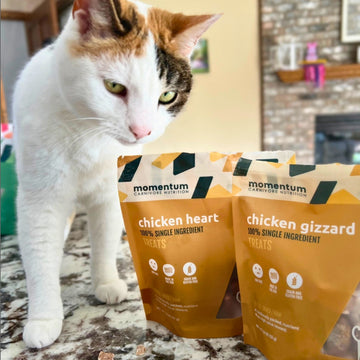
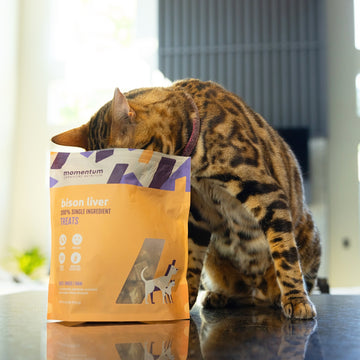
At Momentum Carnivore Nutrition, every single-ingredient treat and every Training Bites flavor is freeze-dried – no heat, no fillers, one ingredient (or two, for Training Bites) on the label. That includes the hearts, livers, Chicken Breast, Pork Tenderloin, Wild-Caught Salmon, Minnow, and Duck Neck Treats.
Our Icelandic Fish Chews are a different category entirely: they're air-dried, a distinct low-and-slow process from both standard dehydration and freeze-drying, sourced and processed in Iceland's sustainably managed waters. If you're comparing freeze-dried vs. air-dried specifically, that's a separate conversation from freeze-dried vs. dehydrated – see our freeze-dried vs. air-dried breakdown for the full picture.
How to Choose Between Freeze-Dried and Dehydrated Treats
A few questions to ask when you're standing in the treat aisle (or scrolling one online):
- Do you want the closest thing to raw nutrition? Freeze-dried is the better fit, since it skips heat entirely.
- Is your dog a heavy chewer who wants a treat that lasts? A firmer, dehydrated or air-dried chew may hold up better.
- Are you training and need something that breaks into small pieces easily? Freeze-dried single-ingredient treats are typically easier to snap into training-sized bits.
- Is the ingredient label short? Whichever method you choose, look for single-ingredient or limited-ingredient treats over long lists of fillers, binders, and preservatives. That's true regardless of drying method, and it's one of the clearest signs you're looking at one of the best minimally processed dog treats on the shelf.
The processing method matters, but it's not the only thing that matters. A freeze-dried treat made from a single named protein with nothing else added will always be a cleaner choice than a dehydrated treat padded with fillers, and vice versa. Read the ingredient panel first, then decide which texture and process fits your dog.
FAQ
What's the difference between freeze-dried and dehydrated dog treats? Freeze-dried treats are made by freezing the ingredient and removing moisture through sublimation under vacuum, with no meaningful heat applied. Dehydrated treats are made by applying low, continuous heat over several hours to evaporate moisture. Freeze-drying removes slightly more moisture (98–99% versus 90–95%) and avoids heat exposure entirely.
Is freeze-dried or dehydrated better for dogs? Both are considered minimally processed compared to baked or extruded treats. Freeze-drying's lack of heat exposure is generally considered gentler on heat-sensitive nutrients, but dehydrated treats made from a single named protein with no fillers remain a solid, more affordable option.
Do dehydrated treats need to be rehydrated before feeding? No. Dehydrated treats can be fed as-is. Some owners choose to soften them with warm water for puppies, senior dogs, or dogs with dental sensitivities, but it isn't required.
Which Momentum products are freeze-dried? Every Momentum single-ingredient treat and every Training Bites flavor is freeze-dried. Our Icelandic Fish Chews are air-dried, a separate process from both freeze-drying and standard dehydration.
Why don't freeze-dried and dehydrated treats need refrigeration? Both processes remove the vast majority of moisture from the ingredient. Since bacteria and spoilage organisms need water to multiply, reducing moisture to a very low level is what keeps these treats shelf-stable at room temperature without artificial preservatives.
Ready to see freeze-dried done right? Shop our full lineup of single-ingredient freeze-dried treats, or check out our Training Bites for a purpose-built training reward.